How to Winter Sow Seeds Using Ziplock Bags

Winter sowing in zip‑lock bags is simple, low‑cost, and surprisingly effective way to winter sow native milkweed and perennial seeds. It is also a low mess alternative to milk jugs. Ziplock bags act like mini cold frames, letting moisture, light, and fluctuating winter temperatures stratify seeds naturally. They’re lighter and easier to store than jugs, and they warm quickly on sunny days.

Here’s a clear, gardener‑friendly walkthrough to help you get started.

What You Need


Click here to find native perennial seeds for your area.
Prepare the Bag
  • Cut two small drainage slits in the bottom corners.
  • Add 4-5 inches of moist seed‑starting mix.
  • The mix should feel like a wrung‑out sponge.
Sow the Seeds
  • Sprinkle seeds on the surface.
  • Press gently so they make contact with the soil.
  • Cover lightly only if the species requires it (many natives need light to germinate).
Seal for Ventilation
  • Zip the bag almost closed, leaving a ½‑inch gap for airflow.
  • This prevents mold while still holding humidity.

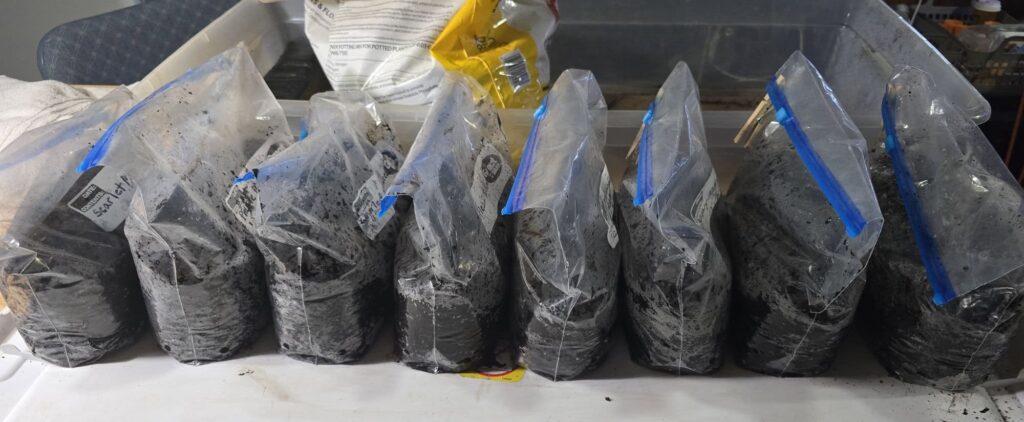
“I started winter sowing today with 8 types of milkweed .🌱 This was just before we hung the bags outside. I have many other bags to prep and hang outside. This was such a successful method for me last year! 😊🌱🦋🐛Jennifer Zolinski Gezequel  

Place Outdoors
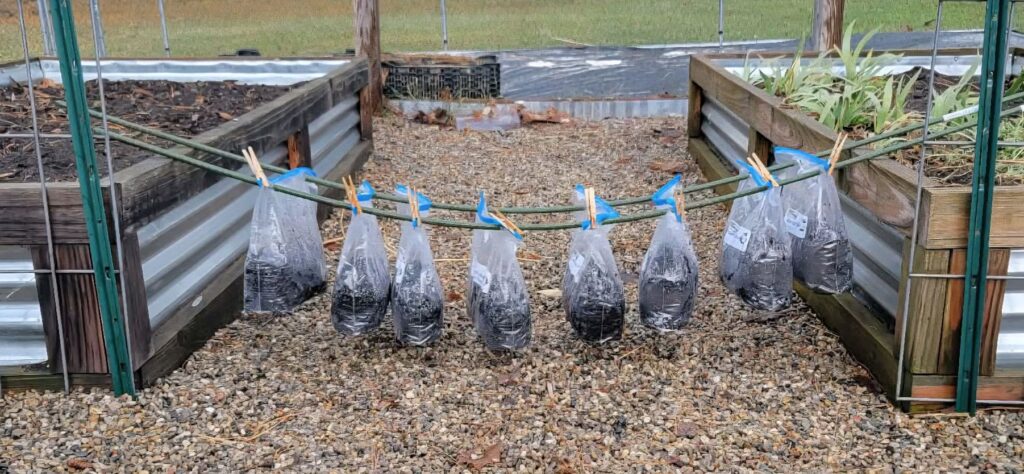
  • Set bags in a bright, open area that gets rain.

Jennifer Zolinski Gezequel hangs ziplock bags using stakes laying across raised beds.

Let Nature Work
  • The freeze and thaw cycles stratify the seeds.
  • Condensation inside the bag is normal and acts like a tiny greenhouse.
Monitor in Early Spring
  • When seedlings appear, gradually open the bag wider over a week to acclimate them.
  • Once they’re sturdy, transplant into pots or directly into the garden after the last frost in your area.

Butterflies on a Chemical Quest: The Alkaloid Attraction

Male butterflies frequently seek out plants that are rich in alkaloids, not simply for nourishment but for pharmacology—the deliberate ingestion of plant chemicals necessary for producing sex pheromones. These pheromones, which are derived from the alkaloids consumed, are stored in specialized scent organs and later released during mating rituals to attract female butterflies.

Male Queen butterfly  sipping nectar from Gregg’s miistflower to get nourishment and to absorb alkaloids needed for mating.

Chemical Attraction and Courtship in Queen Butterflies

A notable example of this behavior is seen in the Queen butterfly (Danaus gilippus). Male Queen butterflies are particularly attracted to Gregg’s mistflower (Conoclinium greggii) due to a unique chemical interaction that significantly influences their mating behavior. Gregg’s mistflower produces a high concentration of alkaloids, especially pyrrolizidine alkaloids, which the male butterflies actively seek.

Male Danaus gilippus butterflies—commonly known as Queen butterflies—are especially drawn to Gregg’s mistflower (Conoclinium greggii) due to a fascinating chemical interaction that plays a role in their mating behavior.

After consuming these compounds, the males convert them into sex pheromones that are stored in specialized scent patches on their wings, known as androconial organs. During courtship, the males release these pheromones to signal their fitness and appeal to potential mates.

Mating occurs mostly midafternoon. A male seeks out a female near milkweed plants. He will hover over her releasing a sex pheromone that makes her receptive to mating.

Why Gregg’s Mistflower Is a Preferred Choice

Gregg’s mistflower stands out among native plants because of its particularly high alkaloid content. This makes it a key resource for male butterflies seeking the chemicals necessary for pheromone production. In addition to its chemical properties, Gregg’s mistflower boasts a long blooming season and dense clusters of lavender-blue flowers, providing an abundant nectar source. This combination of chemical and nutritional benefits makes the plant exceptionally attractive to male butterflies, serving both their reproductive and dietary needs.

Among native plants, Gregg’s mistflower is especially rich in these alkaloids, making it a hotspot for male butterflies. Purchase Gregg’s Mistflower seeds here: https://amzn.to/42dqx2Q

Monarch RX

A new citizen-science project, Monarch Rx, explores this little-known behavior in monarch butterflies called PA-pharmacology, where they scratch at and sip from leaves of non-milkweed plants containing pyrrolizidine alkaloids (PAs). These compounds, found in plants like boneset and mistflowers, provide defense against predators and potentially aid in mating and disease resistance.

A monarch butterfly gathers substances that may help bolster defenses. Using its proboscis, it applies fluid to create a liquid solution so that it can then imbibe. https://www.humanegardener.com/monarch-rx-calling-all-butterfly-watchers/

The project invites the public to report observations of this behavior to gather data on plant diversity and frequency of PA-gathering. Collaborators hope this initiative will shed light on an overlooked aspect of monarch butterfly behavior and inspire further research into their association with PA plants.

Check out the Monarch Rx project on CitSci.org, where you’ll find links to the paper, a one-page primer about the topic, and a place to put on record the many observations we hope you’ll make.

Quick Links to More Info:

Read the paper in Ecological Entomology: The puzzle of monarch butterflies (Danaus plexippus) and their association with plants containing pyrrolizidine alkaloids

Read the paper in News of the Lepidopterists’ Society: Monarch butterflies gather pyrrolizidine alkaloids from dead and injured plants: a call for citizen science contributions

Read the article in Entomology TodayNew Citizen-Science Project Explores Little-Known Behavior in Monarch Butterflies

Read the article in the Wild Ones JournalMonarch Rx: Butterflies Obtain “Drugs” from Withering Plants

Listen to the podcast with Joe Lamp’l of Joe Gardener: Monarch Rx: The Prescription for Healthier Butterflies

Read the primer: Summary and Fact Sheet about Monarch and PAs


How Do Monarchs Migrate

Have you ever wondered a migrating monarch can fly up to 2,500 or sometimes even 3,000 total miles from Canada and Northern United States and find the exact location they need to find in Mexico to overwinter? None of the monarchs on the fall migration path have ever been to their destination before, and yet they know exactly where to go.

Monarch butterflies know to migrate south because their genes give them an internal “clock” and instructions for navigation. They use a complex system involving a time-compensated sun compass, a circannual clock, and possibly Earth’s magnetic field to fly south. Specialized cells in their antennae and eyes help process these cues, enabling them to fly in the correct direction even on cloudy days to reach overwintering grounds in Mexico, a place they’ve never been before.

Monarch butterfly antennae are far more than delicate feelers—they’re precision instruments for navigation. During their epic migration, these antennae play a crucial role in helping monarchs orient themselves and stay on course.

Internal Clock in the Antennae

Monarchs use a circadian clock located in their antennae to track time of day. This clock syncs with the position of the sun, allowing them to use a “sun compass” in their brain to determine direction. Without this timekeeping mechanism, they’d misinterpret the sun’s position and veer off course.

The brain integrates signals from the antennae’s clock with visual cues from the sun. This coordination helps monarchs maintain a southward trajectory toward their overwintering sites in Mexico.

So in essence, monarch antennae are like nature’s GPS satellites, keeping time, syncing with celestial cues, and guiding these tiny travelers thousands of miles with astonishing precision.

References:


Velvet Wings and Toxic Beauty: The Enigma of the Pipevine Swallowtail

If a pipevine swallowtail flutters through your garden, prepare to be spellbound by shimmering iridescent blue hindwings. The wings truly are beautiful but they do serve an important role in protecting the butterfly from predators. The wings are a warning that this butterfly is toxic. Pipevine swallowtails pack a toxic wallop because they ingest poisons from their food plant, Dutchman’s pipe.

As the pipevine flutters it wings the sunlight

The pipevine swallowtail  (Battus philenor) can be found across North America, spanning from the southeastern United States up into Canada and south into Central America. Specifically, they can be found in the eastern and southern United States, extending west to Arizona and with an isolated population in central and northern California. They are also found in southeastern Ontario, Canada, and southward into Mexico and northern Central America.

The core range is concentrated in the southern half of the United States and continues south into Mexico and parts of Central America. Pipevine Swallowtails can be found in areas outside their typical range, sometimes straying into places like Minnesota.

Pipevine swallowtails prefer warm climates and are commonly found in open woodlands, meadows, and gardens. They are particularly attracted to areas where their host plant, the pipevine (Aristolochia), grows.

word

Host Plant Relationship: Aristolochia Bond

Pipevine swallowtails feed on Aristolochia (pipevine), a plant rich in aristolochic acid. This toxin makes the butterfly unpalatable to predators—nature’s way of saying “look, but don’t bite”. The caterpillars store aristolochic acids from the plants, and render themselves, their pupae form, their adult form, and their future eggs distasteful and toxic —a brilliant defensive strategy.

Aristolochia species are commonly known as pipevines or Dutchman’s pipes because the flowers of some species are shaped like tobacco pipes.  Aristolochia species contain aristolochic acids, potent toxins that deter most herbivores.

Species such as the spicebush swallowtail, Eastern black swallowtail, red-spotted purple, and female Eastern tiger swallowtails have developed similarities in appearance to pipevine swallowtail butterflies. This mimicry functions as a method to reduce predation by causing predators to perceive them as potentially toxic.

Lifecycle

Pipevine swallowtail females search for pipevine plants when it’s time to lay their eggs, and they often lay clusters of reddish-brown eggs on young leaves or stems.

A female depositing eggs on a tendril of the vine.
Females typically lay eggs in clusters so when the caterpillars hatch and feed together they form a living warning signal in shades of black and orange.

Pipevine caterpillars display a striking black coloration accented by red spines and dorsal spots, making them particularly unappealing to would-be predators. Their hues can shift with temperature—warmer conditions often deepen their tones from black to reddish shades.

When threatened, the caterpillar will flash its osmeterium,  a fleshy orange forked gland at the top of the head  emitting a very noxious odor to ward off predators.

The caterpillars are gregarious in their early days, which means they hang out in groups feeding together. When they get a bit bigger, they tend to go their own way. As the pipevine caterpillar grows, its appearance starts to change as well. It slowly becomes darker and has more pronounced dots of color and longer black tubercles on the front of their heads, which look like antennae.

Lee Miller holds a leaf with several pipevine caterpillars feeding on one leaf.

The chrysalis of Battus philenor can be recognized by its segmented, inward-curving posterior end. Its ventral thorax arches upward, and the head bears a pair of horns on the anterior dorsal side. Remarkably, even in this vulnerable stage, the butterfly appears to deter predators with its formidable form.

The chrysalis is suspended by a silk girdle and blends in with the green leaves helping it to camouflage from predators.

Adult Pipevine swallowtail might appear black at first glance. Its upper wings are velvety black, absorbing light like charcoal silk. The hindwings—the rear pair of wings—shimmer with iridescent blue or blue-green, colors especially vivid in males and glowing even brighter under sunlight. The edges of the wings are scalloped, meaning they have a gently wavy outline that gives the butterfly a soft, undulating silhouette as it moves.

Males have iridescent blue hindwings, minimal white spotting. Often more vibrant in sunlight.

Female pipevine swallowtails have duller blue hindwings and prominent white spots on forewings.

The bottom half of the ventral hindwing of both sexes is metallic blue. A single row of seven orange spots and small pale, cream dots are found at the edge of the wing embedded in the blue section. This is the pipevine swallowtail’s most identifiable characteristic.

The orange spots serve as a warning to predators thatthe butterfly is toxic.


Each stage of the pipevine swallowtail mirrors themes of growth, vulnerability, and renewal. From the egg’s quiet promise to the adult’s shimmering flight, the pipevine swallowtail embodies resilience and transformation.

An Ode to a Beloved Plant~Common Milkweed

One of the most cherished members of the milkweed family, Asclepias syriaca, commonly known as common milkweed, holds a special place in the hearts of many plant enthusiasts including mine. This resilient perennial plant is native to North America and can often be seen gracing the fields, roadsides, and gardens with its lush green foliage and clusters of fragrant pink flowers.

Common milkweed growing in a field in North Carolina.

I truly enjoy strolling through a field of blooming common milkweed. The fragrance of its flowers is captivating, drawing in not just monarch butterflies but also attracting a myriad of pollinators, including bees, butterflies, and hummingbirds, and an abundance of fascinating insects.

If you love common milkweed (Asclepias syriaca) as much as I do, you will love this poster from Where’s Wildlife! You can purchase it here: https://amzn.to/3Rd6ImL

Common milkweed can grow up to six feet tall, showcasing broad, oblong leaves that are arranged in pairs along the stem. The plant’s most striking feature is its spherical clusters of pinkish-purple flowers that bloom from late spring to early summer. Each flower is a masterpiece of nature.

Milkweed flower clusters consist of multiple individual flowers that arise from the stems of a single branch.

One of the most significant roles of Asclepias syriaca is its relationship with the monarch butterfly. Monarchs rely on milkweed species for their life cycle, using the plant as a host for laying eggs. The caterpillars then feed exclusively on milkweed leaves, which provide them with the necessary nutrients and toxins to deter predators. This symbiotic relationship highlights the critical role of common milkweed in supporting monarch populations.

Gardening for Butterflies: Monarch Butterfly Lifecycle
Source: Fix.com Blog

Asclepias syriaca offers numerous benefits when planted, both environmentally and ecologically. Here are a few key highlights:

Provides a Host Plant for Monarch Caterpillars

One of the most compelling reasons to plant milkweed is to support monarch butterflies, whose populations have declined by over 90% in recent decades. Monarchs lay their eggs exclusively on this plant, and their caterpillars rely on its leaves as their only food source. Without milkweed, monarch populations would collapse.

A 5th instar monarch caterpillar feeding on common milkweed growing on the sore of the Mississippi River.

Milkweed flowers provide essential nectar for adult monarch butterflies, fueling them for reproduction and long migrations.

Milkweed flowers provide essential nectar for adult monarch butterflies, fueling them for reproduction and long migrations.

Read more about the important symbiotic relationship between monarchs and milkweed here: https://butterfly-lady.com/monarchs-and-milkweed/

Supports Pollinators

Milkweed isn’t just for monarchs—it’s a pollinator powerhouse. Its flowers produce abundant nectar, attracting not just monarchs but also native bees, honey bees, hummingbirds, and other butterfly species. This nectar sustains pollinators throughout the growing season, supporting biodiversity. By planting milkweed, you create a food-rich habitat, ensuring a steady supply of nourishment for wildlife in your garden or natural landscape.

Promotes Biodiversity

A milkweed patch can turn into a bustling hub of biodiversity, supporting various insects and contributing to a healthier ecosystem. A milkweed patch is far more than a pretty corner of the garden—it’s a living, breathing hub of biodiversity. Once established, it becomes a magnet for life, drawing in a vibrant cast of pollinators, predators, and herbivores alike.

Read more here
Low Maintenance

Once established, milkweed is hardy and drought-tolerant, making it an excellent choice for gardeners looking for a low-maintenance plant. It thrives in poor soils without the need for fertilizers or constant attention. This resilience makes it a perfect addition for those wanting a lush garden without the hassle.

Improves Soil Health

Its deep roots help prevent soil erosion and improve soil aeration. Additionally, it can adapt to different soil types, from sandy to clay-rich soils.

The deep taproot system helps break up compacted soil, enhancing aeration and water infiltration. This root architecture also stabilizes the soil, reducing erosion.
Beautiful Blooms

With its fragrant pink or purplish flowers, milkweed adds a lovely aesthetic touch to your garden or landscape. Their star-shaped clusters, tinged with soft pinks and purples, lend a touch of enchantment to any garden. These blooms are as alluring to the nose as they are to the eye, releasing a gentle fragrance that drifts through the warm summer air. Milkweed doesn’t just beautify a space—it transforms it, turning the ordinary into something quietly magical.

If you’re interested in creating a pollinator-friendly garden or contributing to monarch conservation efforts, planting Asclepias syriaca is a wonderful step forward.

Click here to purchase common milkweed seeds.